Transforming Energy Management: Google’s WeatherNext 3 Revolutionizes AI Weather Forecasting for Grid Operators
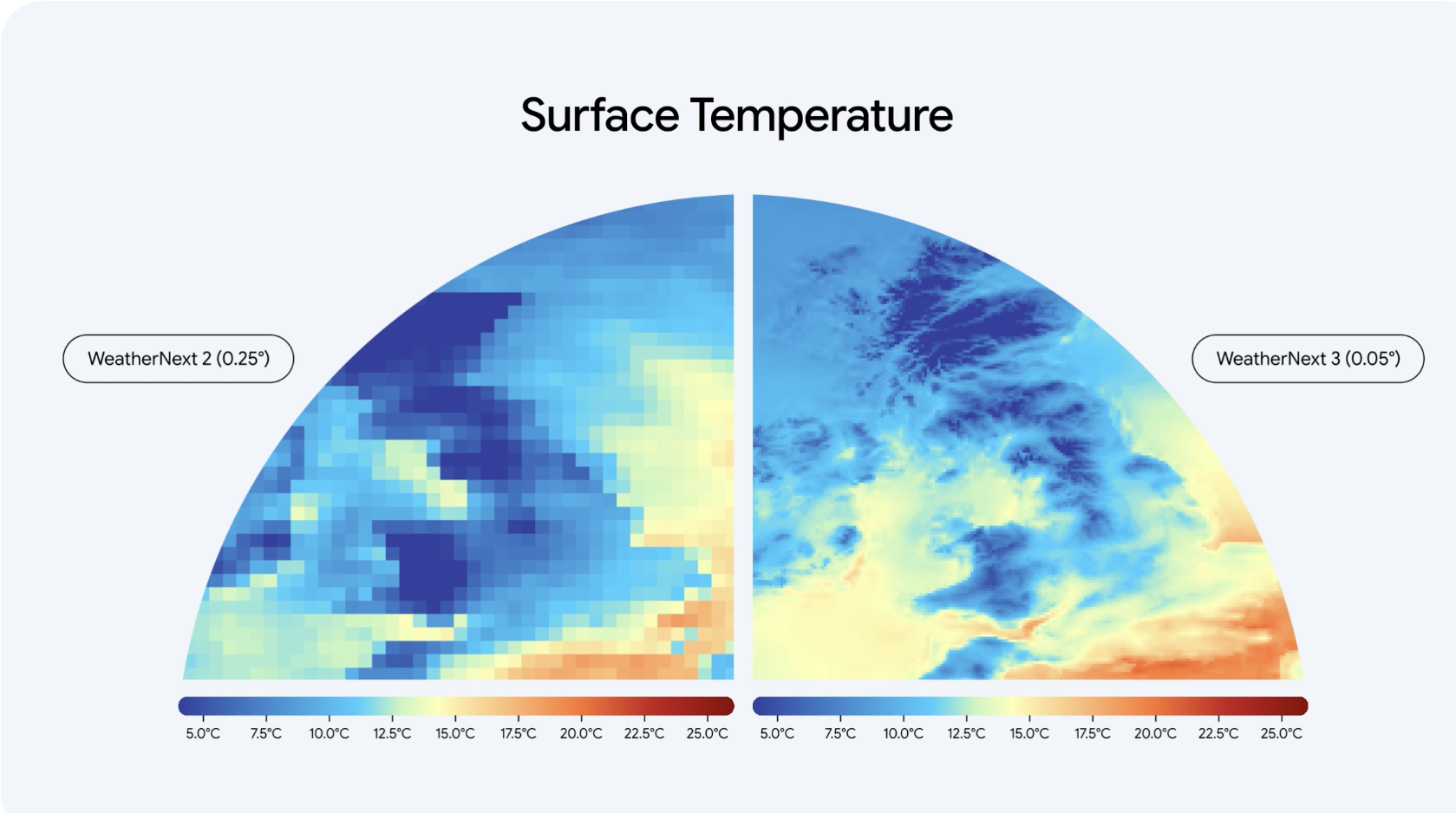
Google is stepping into the future of weather forecasting with its latest AI-driven model, WeatherNext 3. This innovative approach focuses on predicting critical weather variables like wind speed, cloud cover, and sunlight—key data for anyone invested in renewable energy, from traders to grid operators. With updates every hour, Google is shifting the landscape in a market already hungry for precise and timely forecasts.
The Power of WeatherNext 3
Launched on September 3, WeatherNext 3 offers global forecasts at an impressive resolution of up to five kilometers. This new model has evolved from its predecessor, WeatherNext 2, which operated on a 25-kilometer grid and updated every six hours. The enhancements aim to assist grid operators and renewable energy developers in anticipating how much power their solar and wind assets can yield. This predictive capability is essential for matching energy supply with demand effectively.
Notably, the consumer features of WeatherNext 3 are garnering attention. Now, real-time weather forecasts power Google Search, the Gemini app, Google Maps, and the Google Maps Platform Weather API. However, the enterprise aspect is where the financial stakes are higher. Businesses can easily query the forecast data via BigQuery and Earth Engine or download it in bulk from Google Cloud Storage without needing complex setups.
Why the Energy Sector Embraces AI Weather Forecasting
The energy sector is evolving rapidly. With renewables taking center stage, most new generation capacity is now coming from sources like solar and wind. According to S&P Global Market Intelligence, solar and energy storage are leading the charge, projecting over 90GW of planned additions in the U.S. this year.
- Solar and wind generation are inherently dependent on weather conditions.
- Each gigawatt of new capacity makes short-term weather forecasts increasingly accurate.
On the consumption side, the rise of AI is driving electricity demand. Data centers are spreading across North America, contributing significantly to this surge. Deloitte projects that demand growth could peak at 26% by 2035, with data centers alone potentially consuming 176GW—five times more than in 2024.
When predictions fail, the consequences are tangible. If a grid operator miscalculates wind energy production, they may have to procure electricity at a premium from standby gas plants. Conversely, overestimation can result in solar and wind farms being curtailed, costing them revenue and creating inefficiencies.
Competitive Landscape of Weather Forecasting
The market for weather forecasts tailored to the energy sector is well-established, featuring competitors like Vaisala, Solcast, DNV’s WindGEMINI, and IBM’s HyperWatch. Notably, Jua, a Swiss firm, claims its EPT-2 model surpasses others in accuracy, boasting 24 updates daily compared to the typical four offered by competitors.
Google holds a unique advantage through its wide-reaching ecosystem. The same forecast data appears in multiple formats—BigQuery, Earth Engine, and Google Maps—giving it an unparalleled presence. The model’s hourly refresh rate also narrows the gap that competitors previously exploited as a hallmark of their services.
However, traditional models still have defenders. Some argue that physics-based forecasts fare better during extreme weather events because they rely on established principles governing atmospheric movements. This point is especially relevant for grid operators who must prepare for highly unpredictable conditions.
Innovations and Realities of WeatherNext 3
WeatherNext 3 distinguishes itself by deploying real-time observational data rather than relying on traditional simulations. While many AI forecasting models, including WeatherNext 2, were built on output from numerical weather simulations, WeatherNext 3 leverages live satellite imagery and data from weather stations.
Despite the hype, the actual improvements may be narrower than advertised. Google’s architecture still utilizes historical data alongside current observations, leading to a data lag that remains at approximately three to four hours—an improvement, but not entirely absent.
While Google cites up to a 60% increase in accuracy compared to NASA’s IMERG satellite product, these figures require nuance. The highest claims pertain to forecasts made a day or more in advance, with the “up to” qualification indicating best-case scenarios rather than standard performance.
Google’s Increasing Influence in the Energy Sector
As Google ventures into weather forecasting, it does so within a challenging context—an energy sector increasingly strained by demands its operations have helped create. The rapid expansion of data centers, including Google’s own, has further complicated load forecasts for utilities.
For a company that relies on precise energy production forecasts to match renewable energy supply with fluctuating demand, WeatherNext 3 represents critical commercial logic. This new tool aims to provide greater accuracy and responsiveness but has yet to disclose pricing for enterprise access.
Now is a pivotal moment for Google and the energy sector. As technologies converge in the pursuit of smarter, more efficient energy management, WeatherNext 3 could redefine how industries respond to weather-related challenges, delivering valuable insights to those dedicated to a sustainable future.
Embrace the future of energy management and stay informed about innovative solutions like WeatherNext 3. Together, let’s navigate the path toward a sustainable energy landscape, one forecast at a time.