Introducing Claude Opus 5: Anthropic’s New AI Challenger to Fable 5 in Key Tasks

Anthropic has officially unveiled Claude Opus 5, the newest iteration in its cutting-edge AI lineup, designed to excel in coding, research, business applications, and a variety of complex tasks. With remarkable advancements over its predecessor, Opus 4.8, this model promises substantial performance gains while retaining the same API pricing. Enthusiasts have noted that Opus 5 is inching closer to competing with Claude Fable 5 in certain coding scenarios, all while dramatically reducing costs per task.
Available across all Claude applications and API platforms, Opus 5 now stands as the default model for Claude Max subscribers, solidifying its position as the most robust option in the Claude Pro tier.
How Close is Claude Opus 5 to Fable 5?
When put to the test, Opus 5 achieved a remarkable score on CursorBench 3.2, which evaluates coding agents on authentic software development challenges. Impressively, it finished within a mere 0.5% of Fable 5’s highest score at full capacity, and it delivered this result at just half the cost per task.
Claude Opus 5 OSWorld 2.0 benchmark
Credit: Anthropic
Furthermore, Opus 5 outperformed Fable 5 in the OSWorld 2.0 benchmark with a cost-effectiveness ratio exceeding a stunning third. This test specifically measures the efficiency of AI agents in managing computer functionalities and executing tasks across applications.
For both Pro and standard Team subscribers, Opus 5 could mimic the capabilities of Fable 5, especially since the latter is transitioning to a pay-as-you-go credit system starting July 20.
How Much Better is Opus 5 Compared to Opus 4.8?
According to Anthropic, Opus 5 showcases more than double the performance of Opus 4.8 on the Frontier-Bench, which rigorously tests AI agents against complex software engineering tasks. Remarkably, it completes these challenges at a lower average cost.
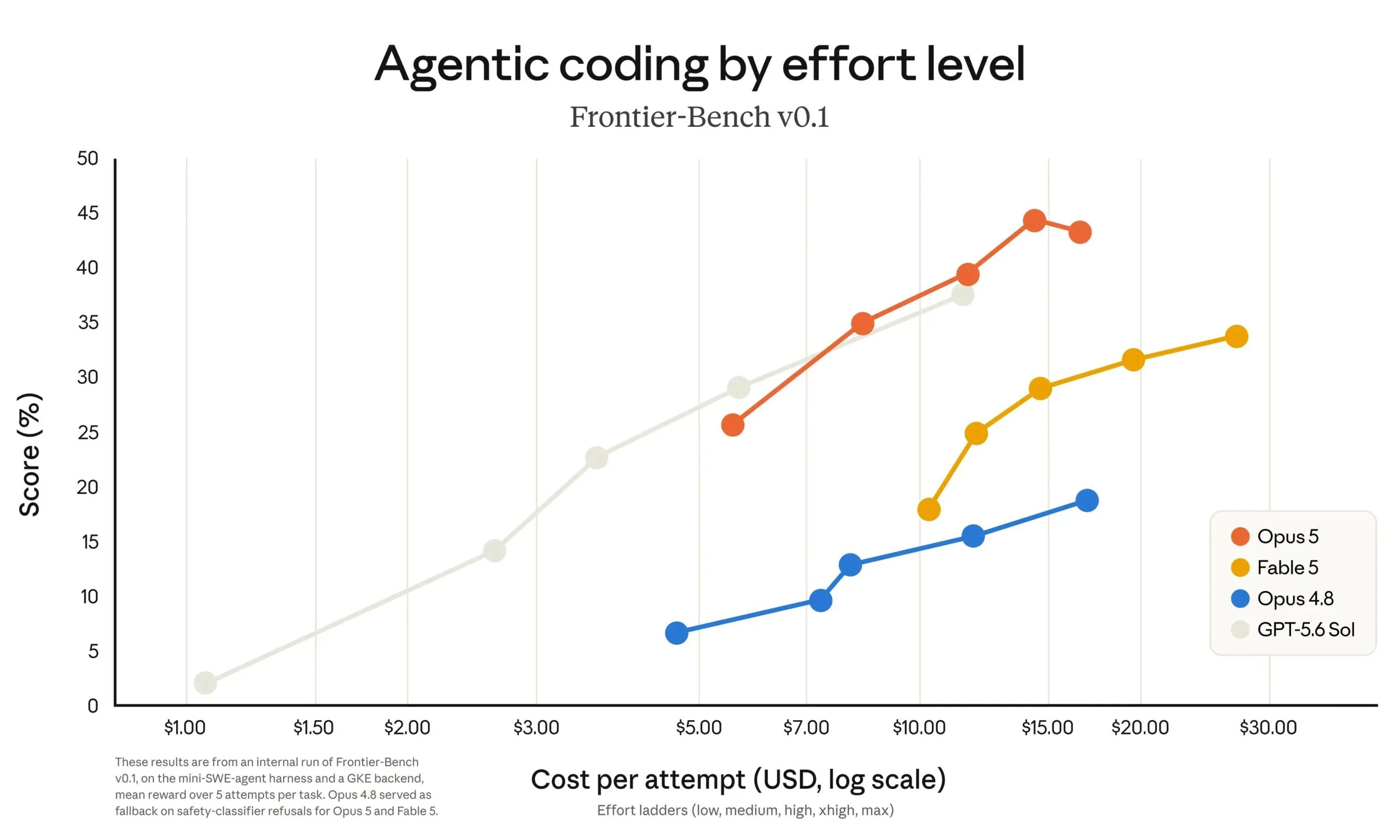
Claude Opus 5 Frontier-Bench v0.1 benchmark
Credit: Anthropic
Among its standout features, Opus 5 excels in validating its work, diagnosing bug origins, and persisting through difficult tasks rather than faltering after a brief solution. In one particularly impressive instance, it identified an edge case that was overlooked by an existing community patch.
While these assessments stem from Anthropic’s proprietary testing, it’s important to remember that performance can vary across different daily workloads. Notably, Opus 5 maintains an unchanged pricing structure of $5 for every million input tokens and $25 for every million output tokens, perfectly aligning with its predecessor.
In this rapid-paced world of technology, having access to tools like Claude Opus 5 can significantly elevate your work efficiency and creativity. If you’re eager to harness the power of advanced AI for your tasks, why not dive in and explore how Opus 5 can transform your projects today? Embrace the future of intelligent assistance—your next breakthrough awaits!