Transform Your AI Usage: Insights from a Groundbreaking Study You Can’t Ignore

The Problem Isn’t AI: It’s How You Use It
Navigating the world of technology often feels like walking a tightrope; the balance between convenience and critical thinking is delicate. For those of us conscious of beauty and sophistication, understanding the nuances of AI can vastly enhance our daily lives. Yet, an intriguing new study has brought forth essential insights that might make us rethink our reliance on these advanced tools.
The Study’s Revelations: A Cause for Reflection
A recent research initiative, encompassing three separate randomized experiments focusing on math and reading comprehension, unveiled compelling findings. After just ten minutes of using AI for problem-solving, participants exhibited a noticeable decline in performance when they lost access to that AI resource. They struggled more and gave up more quickly than individuals who had never relied on AI assistance.
This outcome is notable because it highlights a fundamental truth: the issue isn’t inherently with AI technology itself, but rather with how we choose to engage with it.
Understanding the Usage Patterns
Interestingly, the participants who sought answers directly from AI showed the most significant declines in both performance and persistence. Conversely, those who utilized AI for hints or clarifications displayed no detrimental effects and their performance was statistically on par with the control group.
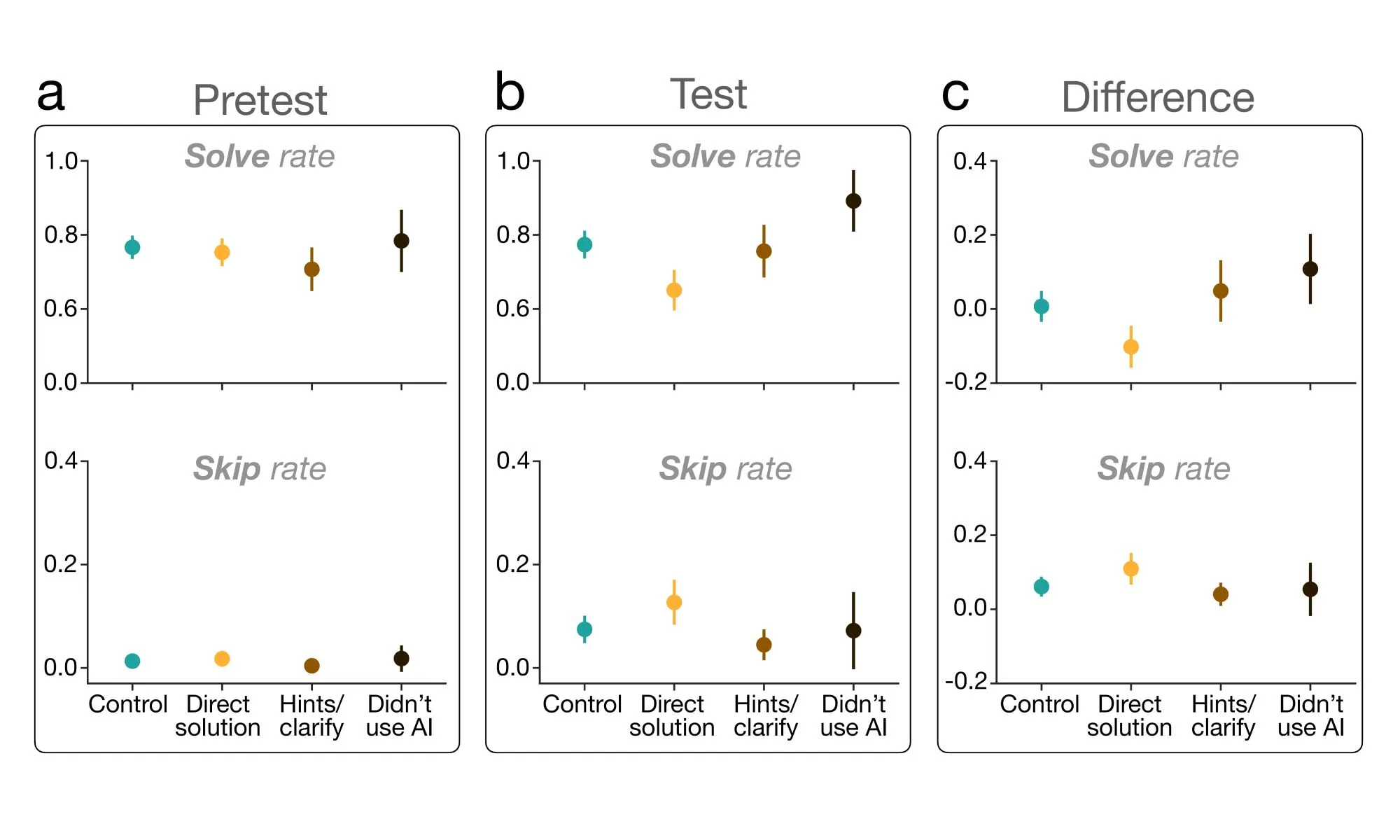
This distinction prompts a shift in our approach to AI. Instead of asking, “Should I use AI?” we should be pondering, “What exactly am I asking AI to do?”
Rethinking Your AI Habits
If you often find yourself using AI to offload tasks, consider this a wake-up call. Relying on AI for instant answers may train our brains to expect assistance rather than encouraging perseverance in problem-solving. The implications of this trend, as researchers caution, could gradually undermine the critical faculties that AI is designed to enhance.
It’s crucial to recognize that while AI can be an incredible asset, becoming too dependent on its responses can hinder our intellectual growth.
A Personal Approach to AI Engagement
As I reflect on my own AI usage, it’s clear that awareness is key. Moving forward, I’ll be more intentional about my requests:
- Am I seeking a fact?
- Do I need a direction?
- Am I looking for a simple sanity check?
- Or am I just looking for someone to think for me because I’m feeling overwhelmed?
The first three approaches are generally constructive, but the last may lead to dependency that can stifle creativity and critical thinking.
Embrace Change for a Brighter Future
Realizing the potential pitfalls in how we utilize AI is the first step toward fostering a healthier relationship with technology.
Let’s not abandon these remarkable tools, but rather embrace them with a mindset that prioritizes active engagement and thoughtful inquiry. By doing so, we not only enhance our capabilities but also ensure that our essential human faculties remain sharp.
Reflect on your AI habits today, and remember, it’s not merely about using technology—it’s about cultivating a mindset that supports genuine growth, creativity, and independence. Let’s journey together towards a more mindful engagement with AI!