Understanding Trump’s AI Executive Order: Will Startups Face Legal Uncertainty Despite the Promise of a Unified Rulebook?
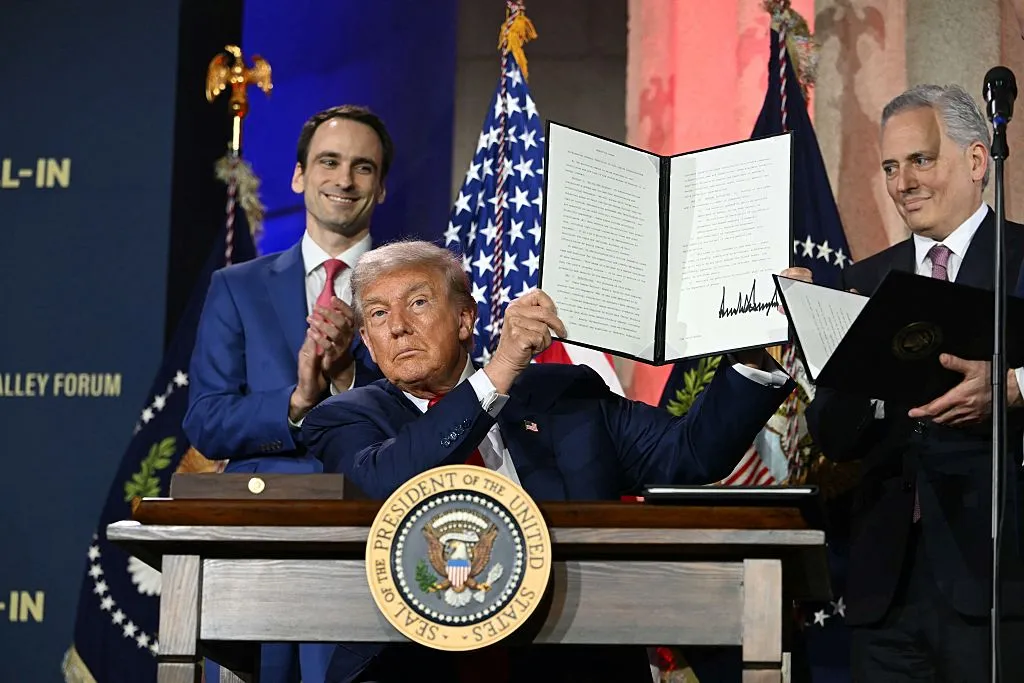
President Donald Trump recently enacted an executive order aimed at redefining how artificial intelligence (AI) is regulated across the United States. This significant move seeks to empower federal agencies to challenge state laws on AI, with the belief that a united approach will benefit startups grappling with a disjointed array of regulations. As the landscape evolves, experts warn that this order might introduce increased legal complexities, leaving young businesses in a state of flux while they await federal consensus.
The Executive Order’s Scope
The order, aptly named “Ensuring a National Policy Framework for Artificial Intelligence,” tasks the Department of Justice with forming a dedicated task force within 30 days to address specific state regulations. The premise? AI is an interstate commerce matter and thus should be subject to federal oversight. The Commerce Department will also take the next 90 days to identify “onerous” state laws that could jeopardize states’ eligibility for federal funds, including vital broadband grants.
Federal Standards and State Law
This executive directive encourages both the Federal Trade Commission (FTC) and the Federal Communications Commission (FCC) to explore national standards that might supersede existing state regulations. The overarching goal is to foster collaboration with Congress toward a uniform AI policy.
Challenges in Implementation
This initiative arises amidst a broader movement to impose restrictions on varying state regulations regarding AI. As legislative efforts in Congress to impose a moratorium on state regulations faltered, lawmakers from both parties expressed concern that a lack of a national standard could leave consumers exposed and companies unchecked.
Critics of the order view it as a potential boon for Silicon Valley elites, noting that it may serve to insulate them from accountability. Michael Kleinman, head of U.S. Policy at the Future of Life Institute, remarked that such moves primarily benefit powerful players.
The Uncertain Landscape for Startups
While proponents assert that federal oversight could mitigate confusion, detractors highlight the immediate challenges for budding firms. Startups will continue to navigate existing state laws until a cohesive framework is established, leading to potentially prolonged periods of uncertainty.
Sean Fitzpatrick, CEO of LexisNexis, predicts that state governments will staunchly defend their consumer protection authority, with legal disputes likely escalating all the way to the Supreme Court. Such legal upheaval could hinder the innovation that defines many startups.
Navigating Regulatory Complexities
Startups often prioritize innovation over compliance with complex regulations, which can become cumbersome and costly. Hart Brown, a principal author of AI-related recommendations for the Oklahoma governor, emphasized the challenges smaller companies face in meeting evolving regulatory standards.
Arul Nigam, co-founder of Circuit Breaker Labs, voiced concerns over self-regulation in a fragmented regulatory environment, questioning whether smaller firms can adhere to non-existent open-source standards during such tumultuous times.
The Impact on Innovation
Andrew Gamino-Cheong, CTO of Trustible, argued that the executive order could stifle innovation. Larger enterprises possess resources to adapt to regulatory changes, while smaller startups may struggle in an unpredictable climate. Legal ambiguity can drive away customers from risk-sensitive sectors, further complicating sales strategies.
The Call for Cohesion
Industry leaders like Gary Kibel of Davis + Gilbert support the notion of a singular national regulatory standard but caution that an executive order may not effectively override existing state laws. There is genuine concern that without thoughtful regulation, the field could devolve into a chaotic environment, favoring only those big enough to endure the volatility.
Morgan Reed, president of The App Association, urged for swift congressional action to establish a “comprehensive, targeted, and risk-based national AI framework.” The ongoing patchwork of state regulations cannot persist, and extensive legal disputes over the constitutionality of the executive order would be detrimental to all stakeholders involved.
As this conversation around AI regulation unfolds, it is apparent that a balanced approach will be essential for fostering a healthy innovation ecosystem. To stay informed and navigate these developments effectively, businesses need to engage with policymakers, share insights, and advocate for frameworks that promote accountability while nurturing innovation.
Join the conversation and take an active role in shaping the future of AI regulation. Your voice matters in this crucial dialogue!