Understanding AI Agents and Agentic AI: Essential Differences Explained

In the ever-evolving world of artificial intelligence, understanding the nuances between different types of AI is crucial. Two terms often thrown around are **AI agents** and **agentic AI**—though they might seem similar, they actually represent different approaches and capabilities in the realm of technology. If you’re seeking clarity on how these systems can impact your business operations, you’ve landed in the right spot.
AI Agents vs. Agentic AI: A Snapshot Overview
Let’s kick this off with a quick comparison to lay the groundwork:
| Aspect | Agentic AI | AI Agents |
|---|---|---|
| Definition | Autonomous systems with goal-directed behavior | Specialized software for specific tasks within defined boundaries |
| Autonomy | High – operates independently | Limited – adheres to set protocols |
| Decision-Making | Advanced reasoning and evaluation | Condition-action rules and algorithms |
| Learning & Adaptation | Continuous learning and adaptability | Updates needed for new scenarios |
| Task Complexity | Handles complex, unpredictable tasks | Excels in specific, well-defined tasks |
| Core Components | Large Language Models, Integrated Tools | Sensors, Decision-making Module |
| Resource Requirements | High – requires robust computing | Lower – economical for designated tasks |
| Cost-Effectiveness | Higher initial costs, long-term value | Lower implementation costs, task-specific |
| Applications | Self-driving cars, personal assistants | Customer service, scheduling, data processing |
Understanding Agentic AI
Agentic AI systems represent a leap in autonomous technology. These systems function independently, possessing the ability to perceive their environment, reason through complex scenarios, and learn from their surroundings. Unlike traditional AI, which responds based on fixed programming, agentic AI takes initiative and adapts its strategies based on real-time feedback.
Agentic AI operates through four key steps:
- Perception: Sensing and interpreting data from the environment.
- Decision-Making: Analyzing gathered information to choose the best course of action.
- Adaptability: Learning from experiences to enhance performance.
- Autonomy: Operating independently toward goal achievement.
This proactive nature allows agentic AI to tackle complex tasks across various applications, from personal assistants to industrial automation.
Core Components of Agentic AI
Three essential elements contribute to the efficacy of agentic AI:
- Large Language Models: The cognitive engine for processing language and orchestrating actions.
- Integrated Tools: Enabling interaction with external systems, enhancing capability beyond text processing.
- Memory Systems: Supporting both short-term tasks and long-term knowledge retention.
Unique Features and Capabilities
Agentic AI shines in several aspects:
- Autonomous task execution
- Real-time adaptability
- Independent decision-making
- Integration with diverse data sources
- Continuous improvement through experience
This adaptability makes it a game-changer in industries with intricate workflows, notably healthcare and finance.
Diving into AI Agents
In contrast, **AI agents** are designed for specific tasks within rigid boundaries. Think of them as specialized digital workers, each programmed to address particular functions efficiently, albeit with limitations. While they can operate autonomously, their decision-making is confined to predetermined parameters.
Common uses for AI agents include:
- Automated customer service solutions
- Data analytics tools
- Scheduling assistants
- Targeted marketing systems
Framework of AI Agents
The underlying structure of AI agents comprises the following components:
- Sensors: Collecting environmental data.
- Perception System: Processing and interpreting that data.
- Decision-Making Module: Assessing paths based on programming.
- Actuators: Implementing the chosen actions.
This framework utilizes a feedback loop to refine future decisions, ensuring continuous improvement.
Applications for AI Agents
AI agents have established their utility across various sectors:
- Healthcare: Analyzing patient information and monitoring vital signs.
- Manufacturing: Streamlining production and supply chain processes.
- Finance: Detecting fraud and automating trading strategies.
- Customer Service: Efficiently managing inquiries and support requests.
- Marketing: Conducting competitor analysis and optimizing strategies.
Breaking Down the Differences: AI Agents vs. Agentic AI
The distinction between AI agents and agentic AI comes down to their capabilities in problem-solving and decision-making:
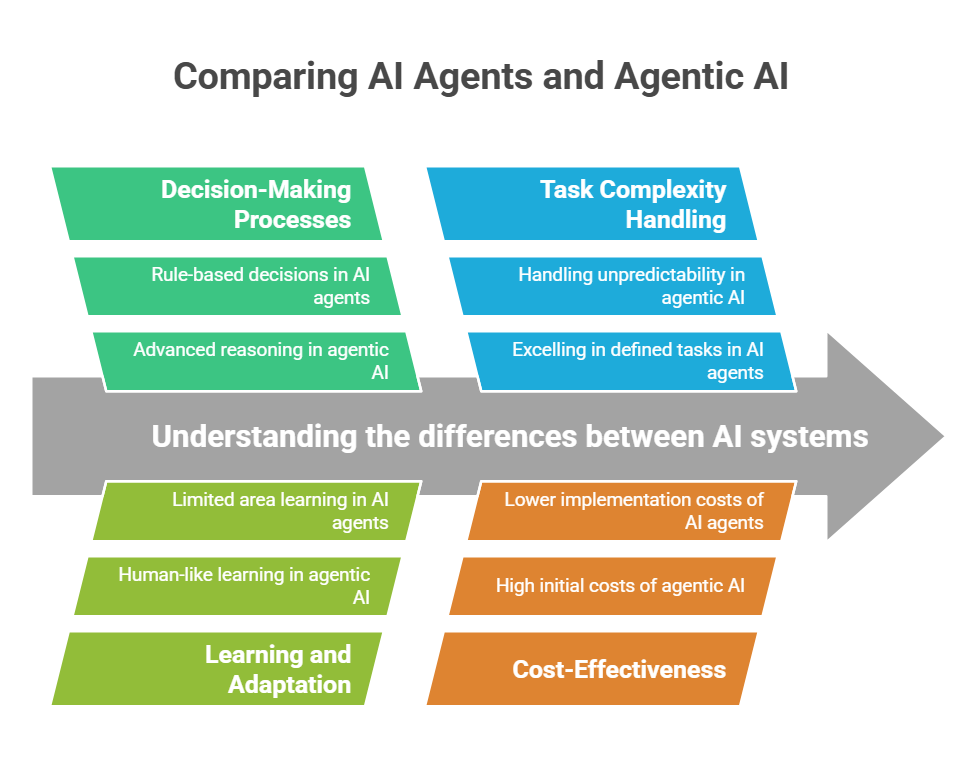
Decision-Making Approaches
While both systems can make decisions, their methodologies differ significantly. Agentic AI leverages advanced reasoning skills to evaluate multiple factors, allowing it to strategize and adjust its approach dynamically. In contrast, AI agents function within fixed frameworks, using simple condition-action rules based on their programming.
Learning and Adaptability
Agentic AI mimics human learning by adapting based on ongoing experiences, leading to improved performance over time. It can generalize knowledge across numerous situations. Alternatively, AI agents possess a more limited learning scope, requiring specific updates for new tasks.
Task Management Complexity
Agentic AI excels at navigating complex, changing environments, breaking down intricate objectives into manageable tasks. AI agents, however, thrive in stable conditions focused on well-defined challenges.
Resource Needs
The infrastructure demands also differ markedly. Agentic AI systems require advanced computational power and extensive data integration capabilities, while AI agents operate effectively with less robust resources, making them a cost-efficient choice for targeted tasks.
Cost Considerations
Initial investments for agentic AI can be substantial due to its complex infrastructure, yet it often yields greater long-term advantages. In contrast, AI agents offer a more budget-friendly solution for businesses with straightforward requirements. Key factors influencing costs include:
- Infrastructure demands: Agentic AI needs advanced resources
- Maintenance requirements: AI agents require less upkeep
- Scalability costs: Agentic AI provides greater long-term value
- Training and updates: Frequent updates are necessary for AI agents
In Conclusion
In summary, understanding the distinctions between **AI agents** and **agentic AI** is vital for making informed decisions that align with your business’s long-term goals. While AI agents efficiently manage specific tasks, agentic AI brings a level of autonomy and adaptability that is hard to overlook. Assessing your organization’s needs and resources will guide you in choosing the right technology.
Are you excited to discover how AI can revolutionize your business approach? Take the leap and explore the potential of AI agents with us today! Don’t miss out on the chance to enhance your operations—start your journey with Chatsonic!


![Transforming Sales: How AI Turns Rejection into Connection [Podcast]](https://aihelpexpert.com/wp-content/uploads/2025/11/Transforming-Sales-How-AI-Turns-Rejection-into-Connection-Podcast-768x768.png)