Revolutionizing Hearing: Cochlear’s Breakthrough with Edge AI-Enhanced Machine Learning Implants

The next stage in the evolution of edge AI medical devices is not found in wearables or bedside monitors—it’s inside the human body. The newly launched Nucleus Nexa System from Cochlear is pioneering this transformation by offering the standout feature of an implant capable of running machine learning algorithms. This remarkable device can manage stringent power constraints, store personalized data on-device, and receive over-the-air firmware updates to enhance its AI capabilities over time.
For AI experts, the challenges are profound. The goal is to create a decision-tree model that can classify five distinct auditory environments in real-time, optimize it for a device with an exceptionally limited power budget—a device that must last for decades—and achieve this intricate task while interfacing directly with human neural tissue.
Decision Trees Meet Ultra-Low Power Computing
At the heart of this revolutionary system is SCAN 2, an environmental classifier that meticulously analyzes incoming audio to categorize it into five types: Speech, Speech in Noise, Noise, Music, or Quiet.
“These classifications are then input to a decision tree, which is a type of machine learning model,” states Jan Janssen, Cochlear’s Global CTO, in an exclusive interview. “This decision adjusts sound processing settings for each situation, enabling the implant to adapt its electrical signals accordingly.”
Interestingly, while the model operates on the external sound processor, the implant itself plays a crucial role in the intelligence through Dynamic Power Management. Data and power are interwoven through an enhanced RF link, allowing the chipset to fine-tune power efficiency based on the environmental classifications provided by the machine learning model.
This innovation transcends mere power management; it’s about solving one of the toughest dilemmas in implantable technology: how do you sustain a device for 40-plus years when replacing its battery isn’t an option?
The Spatial Intelligence Layer
In addition to environmental classification, the system employs ForwardFocus, a spatial noise algorithm utilizing two omnidirectional microphones to construct spatial patterns for target and noise. The algorithm optimally assumes that the target signal originates from the front, while noise comes from the sides or rear, applying spatial filtering to minimize background disturbance.
What stands out here is the automation layer. ForwardFocus operates independently, alleviating the cognitive burden on users traversing complex auditory environments. Decisions on activating spatial filtering occur algorithmically based on analysis, eliminating the need for user intervention.
Upgradeability: The Medical Device AI Paradigm Shift
The game-changing aspect of the Nucleus Nexa Implant is its upgradeable firmware. Traditionally, once a cochlear implant was surgically positioned, its capabilities remained static. New signal processing algorithms and improvements in machine learning models could not enhance the experience of existing patients.
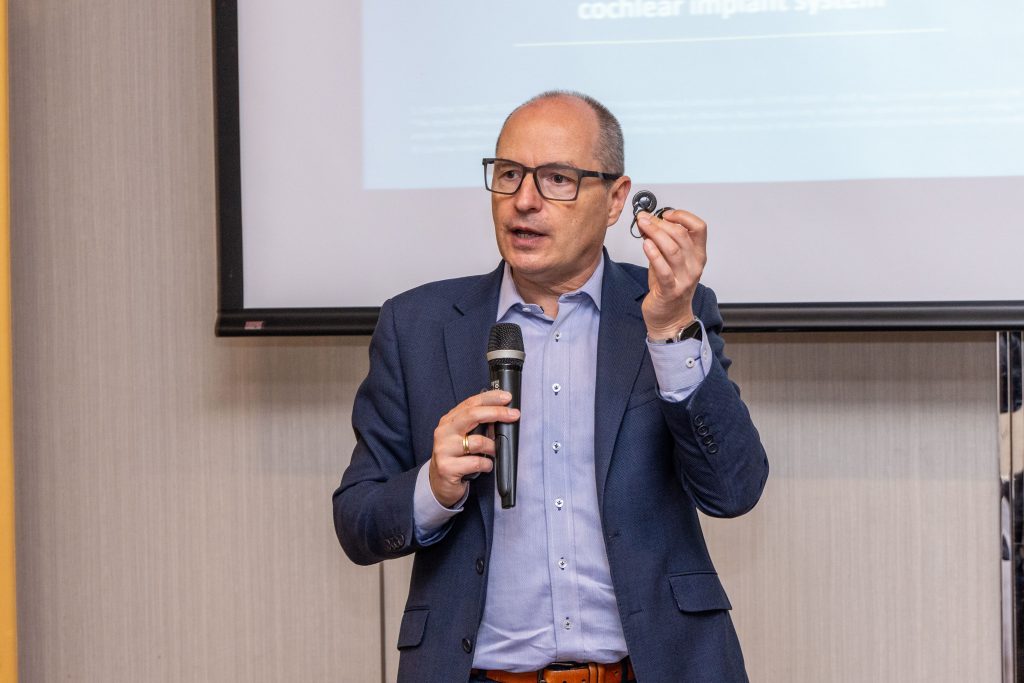
The Nucleus Nexa Implant alters this narrative. Audiologists can now deliver firmware updates directly to the implant via Cochlear’s innovative short-range RF link through the external processor. Such upgrades rely on carefully designed security measures—limited transmission range and low power output ensure that updates require close proximity—combined with robust protocol safeguards.
“With smart implants, we keep a copy of the user’s personalized hearing map on the device itself,” Janssen notes. “If you lose your external processor, we can send you a blank one that retrieves the stored map from the implant.”
The implant can retain up to four unique maps in its internal memory, addressing a significant challenge in AI: maintaining personalized model parameters even when hardware components fail or need replacement.
From Decision Trees to Deep Neural Networks
Currently, Cochlear employs decision tree models for environmental classification—a practical choice considering power limitations and the interpretability required for medical devices. However, Janssen reveals plans for future enhancements: “Artificial Intelligence through deep neural networks, a more complex form of machine learning, could further improve hearing in noisy situations down the line.”
The company also aims to leverage AI for more than just signal processing. “Cochlear is exploring the integration of AI to automate routine check-ups, potentially reducing lifetime care costs,” Janssen highlights.
This vision points to a larger trend for edge AI medical devices: evolving from reactive signal processing to predictive health monitoring, and shifting from manual adjustments to automated optimization.
The Edge AI Constraint Problem
What sets this deployment apart from a machine learning engineering perspective is the intricate constraint stack:
- Power: The device must operate for decades on minimal energy, with battery life measured in full days, despite ongoing audio processing and wireless transmission.
- Latency: Audio processing needs to occur in real-time with imperceptible delay—users cannot tolerate any lag between speech and neural stimulation.
- Safety: As a crucial medical device stimulating neural tissue, any model malfunctions can greatly affect quality of life.
- Upgradeability: The implant requires the capacity for model enhancements over 40-plus years without necessitating hardware replacements.
- Privacy: Health data processing must happen on-device, with rigorous measures in place for de-identification prior to any data entering their Real-World Evidence program for model training across their extensive patient dataset.
These constraints necessitate architectural decisions not typically encountered in cloud-based ML model deployments. Every milliwatt of power counts. Every algorithm must be validated for safety. Every firmware update needs to be infallible.
Beyond Bluetooth: The Connected Implant Future
Looking forward, Cochlear is set to implement Bluetooth LE Audio and Auracast broadcast audio capabilities—both of which will require future firmware updates to the implant. These advancements promise superior audio quality compared to traditional Bluetooth while consuming less power. More importantly, they will integrate the implant into broader assistive listening networks.
Auracast broadcast audio offers direct connections to audio streams in public venues, gyms, and airports—transforming the implant from a solitary medical device into a connected edge AI medical tool involved in ambient computing environments.
In the longer term, the vision includes fully implantable devices that house integrated microphones and batteries, removing the need for external components altogether. At that stage, the prospect of completely autonomous AI systems navigating complex environments within the body becomes a thrilling reality—adapting seamlessly, optimizing power, and streaming connectivity without the need for user intervention.
The Medical Device AI Blueprint
Cochlear’s approach offers a robust blueprint for developing edge AI medical devices facing similar constraints. Begin with interpretable models such as decision trees, fiercely optimize for power, incorporate upgradeability from inception, and strategically plan for lifecycles extending beyond the typical 2-3 years seen in consumer technology.
As Janssen emphasizes, the introduction of this smart implant represents merely “the first step toward an even smarter device.” In an industry driven by rapid iterations, fostering long-lasting products while simultaneously advancing AI technology presents a captivating engineering challenge.
The pressing question is not whether AI will metamorphose medical devices—Cochlear’s current deployment already illustrates this transformation in action. Instead, the query remains: how swiftly can other manufacturers tackle the constraint problem and introduce comparable intelligent systems to the market?
For the 546 million individuals experiencing hearing loss in the Western Pacific Region alone, the speed of innovation will determine whether AI in medicine transitions from prototype to standard care.
If you’re excited to discover how AI can further enhance your well-being and beauty journey, join us in exploring the latest advancements at Malibu Elixir. Embrace innovation and empower your wellness today!