OpenAI Celebrates Major Enterprise Success Following Urgent Response to Google Competition

OpenAI has just released captivating new data that reveals a remarkable surge in the enterprise adoption of its AI tools. Over the past year, the volume of messages sent through ChatGPT has skyrocketed by a staggering eightfold since November 2024. This pivot towards AI is not just a trend; many workers are reportedly saving up to an hour each day thanks to these innovative technologies. The timing of this announcement coincides with an internal “code red” memo from CEO Sam Altman that emphasizes the urgent competitive landscape, particularly with Google making strides in AI.
The Shift Towards AI Dominance
The data underscores OpenAI’s ambitious strategy to redefine itself as the frontrunner in enterprise AI, despite facing stiff competition. Currently, about 36% of U.S. businesses are utilizing ChatGPT Enterprise, noticeably outpacing Anthropic, which sits at 14.3%. Yet, a significant portion of OpenAI’s revenue still flows from consumer subscriptions, putting pressure on them as Google’s Gemini threatens this base. Additionally, they must navigate competition from Anthropic, whose revenue is primarily sourced from B2B sales, as well as from other open-weight model providers targeting enterprise clients.
To solidify its market presence, OpenAI has committed to investing $1.4 trillion in infrastructural advancements over the next few years, making it imperative for the company to nurture its growth in enterprise sectors.
Transformative Economic Impact
Ronnie Chatterji, OpenAI’s chief economist, highlighted during a recent briefing that historical technological advancements, such as the steam engine, have gained the most transformative power when adopted on a larger scale by businesses. He stressed that while individual consumer use is important, it’s the companies that integrate these technologies effectively that will catalyze significant economic benefits.
Growing Integration of AI in Workflows
OpenAI’s findings demonstrate not only heightened adoption among larger enterprises but also an increasing integration of AI tools into daily workflows. Employees aren’t merely sending more messages; they are using OpenAI’s API to engage in complex problem-solving, consuming 320 times more reasoning tokens than a year ago. This suggests that firms are leveraging AI for deeper analysis and understanding, although it may also indicate extensive experimentation with the technology.
The rise in reasoning tokens correlates with increasing energy usage, raising concerns about sustainability. OpenAI has been prompted to address questions surrounding enterprise budget allocations for AI, given the potentially hefty costs involved.
Image Credits: OpenAI
Custom Solutions Becoming the Norm
Another significant trend is the growth in the use of custom GPTs, tools that companies utilize to encapsulate institutional knowledge and automate processes. This figure soared to a 19-fold increase this year, now representing 20% of enterprise messages. BBVA, a digital banking client, exemplifies effective deployment with over 4,000 custom GPTs regularly in use.
Brad Lightcap, OpenAI’s chief operating officer, commented, “This illustrates how individuals are customizing this powerful technology to meet their unique needs.”
Time Savings and Enhanced Capabilities
These streamlined processes have led to notable time savings, with participants in interviews reporting that OpenAI’s products save them between 40 to 60 minutes daily. It’s important to note, however, that this may not encompass the additional time spent learning the tools or correcting AI outputs.
Interestingly, three-quarters of surveyed employees expressed that AI empowers them to perform tasks they previously found unmanageable. Notably, there has been a 36% increase in coding-related tasks beyond traditional tech teams — a trend that could lead to both innovation and potential challenges.
Navigating Potential Vulnerabilities
While OpenAI champions this democratization of skills, there are cautionary notes regarding the potential for increased security vulnerabilities and flaws. Lightcap referenced the newly released Aardvark, an agentic security researcher currently in private beta, aimed at detecting vulnerabilities and bugs.
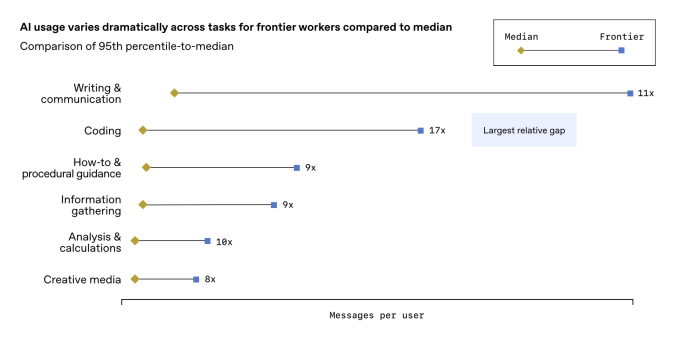
Image Credits: OpenAI
Adoption Gaps in AI Utilization
Despite the active engagement from some ChatGPT Enterprise users, many are not tapping into the most advanced features, such as data analysis and in-depth reasoning. Lightcap remarked on the necessary shift in mindset and deeper integration needed for companies to fully utilize these advanced capabilities, a process that will take time as enterprises reorganize their workflows.
He and Chatterji noted a growing divide in AI adoption practices, where “frontier” workers maximize efficiency with these tools, while others lag behind. This discrepancy suggests a critical need for companies to perceive AI not just as software but as a transformative operating system that can enhance their entire operational framework.
As OpenAI faces mounting pressures amid its ambitious infrastructures, it presents an exciting opportunity for those trailblazing firms still lagging in AI adoption to pivot and catch up. However, for workers training AI to replicate their tasks, the path forward might feel more like a countdown, emphasizing the pressing nature of these advancements.
As we continue to traverse this transformative phase in technology, consider how you can leverage these powerful AI tools to enhance your own work. Together, let’s embrace the future where innovation and productivity are at our fingertips!