Huawei’s Vision: Uniting Thousands of AI Chips for Seamless Computing Power
Imagine harnessing the power of countless advanced AI chips, all working in harmony as if they were parts of a single, colossal computer. This innovative vision was brought to life by Huawei at HUAWEI CONNECT 2025, where the company unveiled a revolutionary AI infrastructure architecture poised to redefine how the world develops and scales artificial intelligence systems.
Moving away from conventional methods that rely on individual servers, Huawei’s groundbreaking SuperPoD technology presents a unified approach, allowing thousands of separate processing units to “learn, think, and reason as one.” This technological leap signifies more than just impressive specifications; it heralds a major transformation in how AI computing power can be orchestrated, scaled, and deployed across various industries.
The Core Innovation: UnifiedBus 2.0
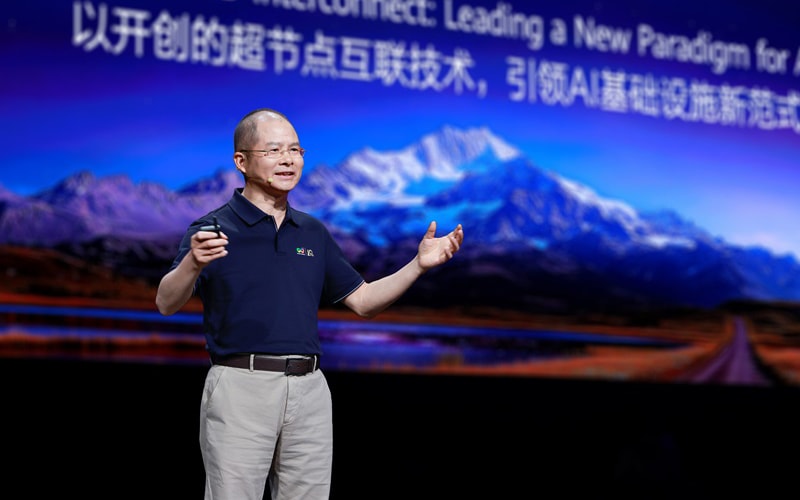
At the heart of Huawei’s innovative infrastructure strategy is UnifiedBus (UB). According to Yang Chaobin, Huawei’s Director of the Board and CEO of the ICT Business Group, this architecture enables an intricate connection between physical servers, allowing them to operate as if they were a single logical server.
The technical intricacies reveal the true potential of this architecture. The UnifiedBus protocol addresses long-standing challenges in large-scale AI computing, namely the reliability of long-range communications and issues of bandwidth-latency. Traditional copper connections are limited in range despite offering high bandwidth, typically linking just two cabinets.
On the other hand, while optical cables allow for longer connections, their reliability diminishes with distance and scale. This is where Huawei excels. Eric Xu, Huawei’s Deputy Chairman, emphasized that overcoming these connectivity challenges is crucial for their AI infrastructure strategy.
Xu elaborated on the solutions developed across the OSI model: “We have integrated reliability into every layer of our interconnect protocol, ensuring flawless communication from the physical to the application layers.”
The Power of SuperPoD Architecture
The Atlas 950 SuperPoD stands as a flagship manifestation of this architecture. With up to 8,192 Ascend 950DT chips, it delivers an astounding 8 EFLOPS in FP8 and 16 EFLOPS in FP4. The interconnect bandwidth boasts an impressive 16 PB/s, making a single Atlas 950 SuperPoD’s bandwidth over ten times greater than the global peak internet bandwidth.
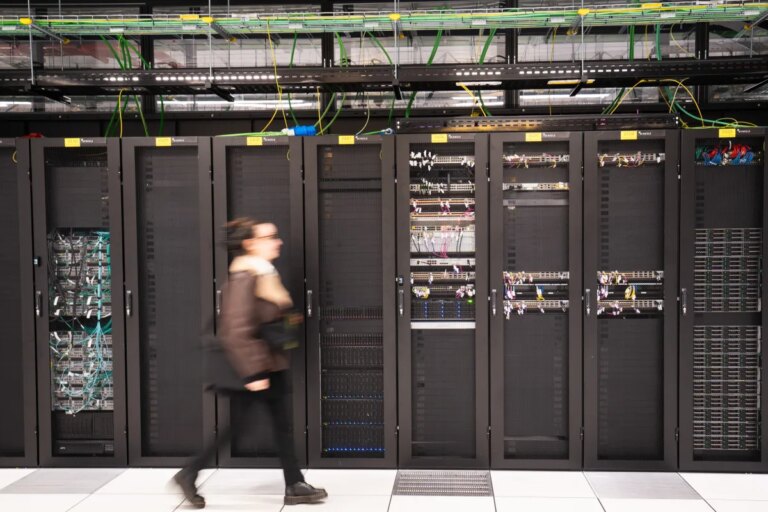
These specifications signify more than mere incremental changes. The Atlas 950 SuperPoD utilizes 160 cabinets within 1,000 square meters, including 128 compute cabinets and 32 communications cabinets linked through all-optical interconnects. It boasts a robust memory capacity of 1,152 TB while maintaining a latency of just 2.1 microseconds throughout the system.
Looking forward, the upcoming Atlas 960 SuperPoD will integrate 15,488 Ascend 960 chips housed in 220 cabinets across 2,200 square meters, promising 30 EFLOPS in FP8, 60 EFLOPS in FP4, 4,460 TB of memory, and an interconnect bandwidth of 34 PB/s.
Expanding Beyond AI: A New Approach to General-purpose Computing
The SuperPoD concept is not limited to AI applications; it also extends into general-purpose computing with the TaiShan 950 SuperPoD. Leveraging Kunpeng 950 processors, this system tackles the challenges faced by enterprises in transitioning from legacy mainframes and mid-range computers.
Xu highlighted its significance for the finance sector, noting that the TaiShan 950 SuperPoD, in conjunction with the distributed GaussDB, offers an exceptional alternative to traditional mainframes and Oracle’s Exadata database servers.
An Open Architecture Strategy
One of the most striking announcements was Huawei’s commitment to releasing UnifiedBus 2.0 technical specifications as open standards. This strategic move reflects both a forward-thinking mindset and pragmatic realities.
Acknowledging that the Chinese semiconductor landscape may lag behind for some time, Xu asserted that “sustainable computing power can only be achieved with technology that is practically available.” Yang further emphasized the importance of building ecosystems, stating, “Our open-hardware and open-source-software approach will empower partners to create industry-specific SuperPoD solutions, fostering innovation and collaboration.”
Huawei plans to open-source a variety of hardware and software components, including NPU modules, cooling systems, AI cards, and more. By December 31, 2025, Huawei intends to fully open-source its CANN compiler tools, Mind series application kits, and foundational openPangu models.
Real-world Impact and Market Deployment
The technical promises of Huawei’s innovations are already being validated in real-world applications. More than 300 Atlas 900 A3 SuperPoD units have been shipped in 2025, serving over 20 customers across multiple sectors, including internet services, finance, telecommunications, energy, and manufacturing.
This groundbreaking initiative holds significant implications for the evolution of China’s AI infrastructure. By fostering an open ecosystem around domestic technology, Huawei aims to surmount the hurdles posed by limited semiconductor capabilities, promoting wider industry participation in AI infrastructure development.
For the global AI landscape, Huawei’s open architecture introduces a refreshing contrast to the tightly controlled proprietary systems prevalent among Western counterparts. However, only time will tell if such an ecosystem can match performance and business viability at scale.
In essence, the SuperPoD architecture marks a revolutionary step forward in AI computing. Huawei is redefining how vast computational resources are interconnected, managed, and scaled. The forthcoming open-source initiatives will either validate collaborative innovation or test its limits, with the potential to reshape the dynamics of the global AI infrastructure market.
With this pioneering spirit, Huawei invites others to join in this transformative journey, inspiring the next generation of technological advancements. Explore the possibilities, and let’s build a future together, one where innovation thrives through collaboration.