Creating Marshmallow Castles: My Experience with Google’s Innovative AI World Generator
Google DeepMind is set to revolutionize the way we experience interactive gaming with the launch of Project Genie. This innovative AI tool allows users to craft their own game worlds using just text prompts or images. Imagine diving into a virtual landscape created entirely from your imagination—sounds enchanting, right?
Starting Thursday, Google AI Ultra subscribers in the U.S. will have access to this exciting experimental research prototype. Powered by DeepMind’s cutting-edge technology, including the Genie 3 world model and the image-generation model Nano Banana Pro, Project Genie aims to reshape the future of entertainment and beyond.
Gathering Insights for the Future
This release comes five months after the initial preview of Genie 3. DeepMind’s strategy is clear: they are eager to gather user feedback and training data as they race towards developing more sophisticated world models. These models create internal representations of environments and can predict future scenarios—an essential step toward achieving artificial general intelligence (AGI).
In the interim, DeepMind envisions a journey that starts with engaging experiences in video games and entertainment, eventually extending to training robots and other embodied agents in simulated environments.
The Growing Competition
With the world model landscape heating up, DeepMind faces competition from various fronts. Notable players include Fei-Fei Li’s World Labs, which recently launched its initial commercial product, Marble. Additionally, AI video-generation startup Runway has introduced a new world model, and Yann LeCun’s AMI Labs is also dedicated to this innovative space.
“I think it’s exciting to be in a place where we can have more people access it and give us feedback,” expressed Shlomi Fruchter, a research director at DeepMind, radiating enthusiasm during a recent interview.
Understanding Project Genie
DeepMind is upfront about Project Genie’s experimental nature. While it can generate compelling game worlds, results can be inconsistent—sometimes achieving impressive creations and other times producing bewildering outputs.
How It Works
To get started with Project Genie, you’ll first create a “world sketch.” Provide text prompts for an environment and a main character, which can later be navigated in either first or third-person view. The image produced by Nano Banana Pro serves as a foundation for your interactive world. Sometimes it hits the mark, but there may be times when Genie delivers unexpected results, like a character with purple hair when you requested green.
You also have the option to utilize real-life images as a basis for your virtual environments, but results can vary significantly.
Once your image is ready, Project Genie quickly transforms it into an explorable world. You can remix existing worlds or dive into the gallery for inspiration before downloading a video of your latest adventure.
Limitations and Current Features
Currently, DeepMind restricts world generation and navigation to 60 seconds. This cap exists not just for user experience but also due to budget and compute constraints. As Fruchter explained, “The reason we limit it to 60 seconds is because we wanted to bring it to more users.” Extending this duration might reduce the tool’s incremental testing benefits.
Whimsy Works, Realism Doesn’t
During my experience with the model, I quickly noticed its safety guardrails in action. Generating content resembling nudity or copyrighted material, such as Disney characters, was off-limits. A previous cease-and-desist from Disney confirmed this caution.
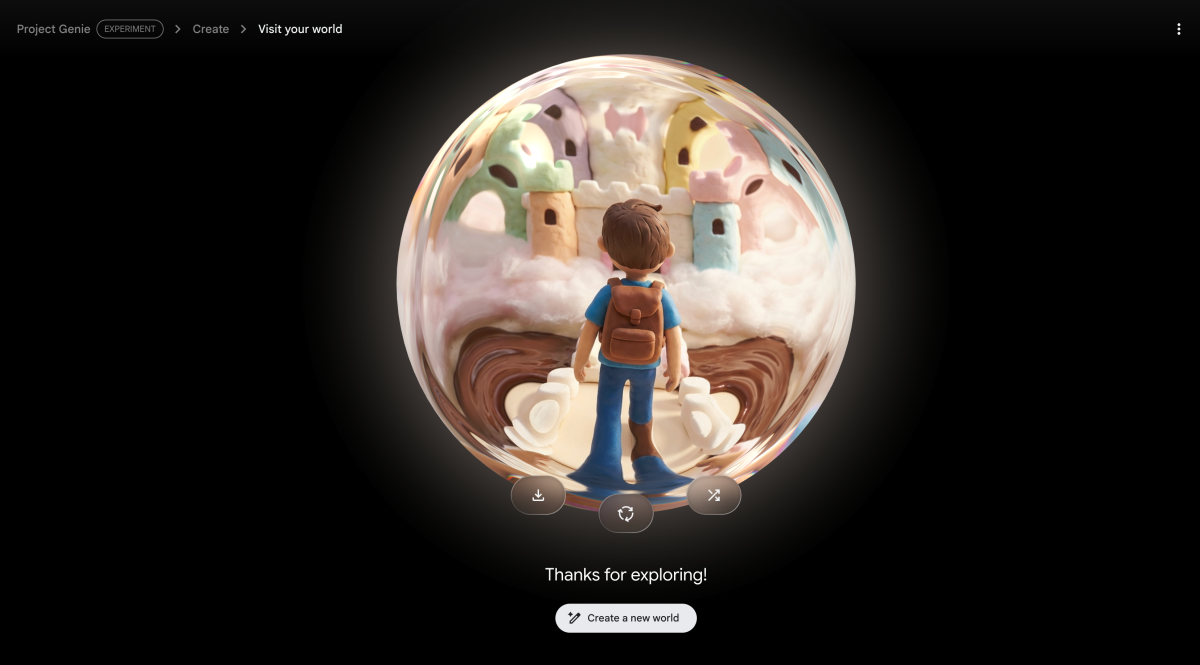
Nevertheless, I was captivated by the initial world I created—a whimsical castle in the clouds made of marshmallows, featuring a chocolate river. The model captured the playful essence perfectly, embodying a childhood fantasy.
Room for Improvement
While Project Genie excels with artistic prompts, it struggles with photorealistic settings. Often, the results look more like video games than real-life scenarios. For example, when asked to create a world based on a photo of my office, Genie gave me a sterile version that lacked true life.
Despite its shortcomings, the interactivity aspect is noteworthy. I animated a stuffed toy navigating space, showcasing some interaction with objects—a promising area for improvement.
Navigational Challenges
Navigating the generated spaces can be tricky. Using keyboard controls—arrows for looking around and W-A-S-D keys for movement—was not intuitive for someone like me who isn’t a frequent gamer. It often felt like steering a shopping cart with a broken wheel, making for a frustrating experience when trying to traverse from one end of the room to the other.
Yet, Fruchter reassured me that the team is aware of these issues and is actively working on enhancements, including more realistic environments and user control.
“We don’t think about Project Genie as an end-to-end product that people can go back to every day,” he said, highlighting the tool’s experimental nature, “but we see glimpses of something unique that can’t be achieved any other way.”
As you reflect on the future of gaming, consider exploring Project Genie for yourself. Let your creativity run wild, and be part of shaping the next wave of interactive experiences. The potential is limitless, and who knows what whimsical worlds you might create? Dive in and let your imagination soar!