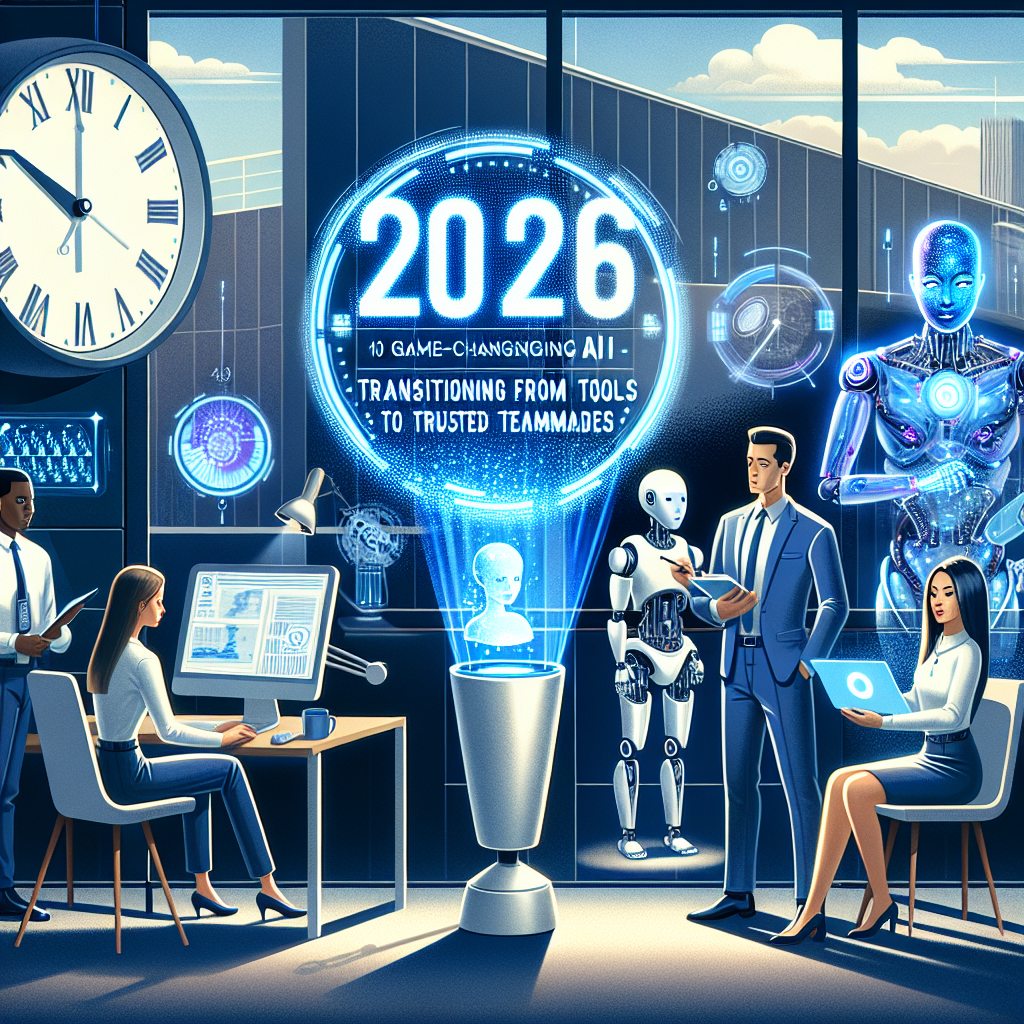
10 Game-Changing AI Predictions for 2026: Transitioning from Tools to Trusted Teammates
As we close out 2025, the landscape of artificial intelligence is evolving in ways we might have only imagined a few years ago. In a recent episode of Prompted, we explored the bold AI predictions for 2026, diving into where we believe this transformative technology is heading. This brief overview captures the essence of our discussion, but I encourage you to watch the full episode for a deeper understanding and join us in the comments to share your thoughts.
Here are our top ten predictions for the AI landscape in 2026.
1) AI Onboarding Becomes Standard Practice
We’re witnessing a pivotal shift as AI moves from the realm of experimentation to a fundamental part of operations.
Organizations will no longer treat AI merely as a tool; they’ll embrace it as an integral team member that requires structured onboarding. Considerations like context, guardrails, and training will become paramount.
When AI is central to workflows, onboarding it effectively is no longer optional—it’s essential.
2) Quality of Model Training Begins to Decline
This prediction reveals a dual challenge for the AI community.
On the supply side, there’s an increasing tendency to train models using AI-generated content. This could risk creating outputs that feel derivative and uninspired.
Simultaneously, buyer fatigue is surfacing. Many users find existing text models sufficiently adequate, making incremental upgrades less noticeable.
As a result, 2026 may not spotlight better models but rather focus on improved applications of existing technologies.
3) AI Roles Flourish in Job Titles
We’re already seeing a shift where AI is infused into more job titles.
Just as roles in SEO and RevOps became essential, expect AI to follow suit across various sectors. We discussed positions like AI GTM roles and AI operations, spotlighting the need for professionals skilled in directing AI functionalities.
The takeaway? The ability to navigate AI will be a distinct advantage in the job market.
4) Personal Context Will Be Portable
As we explore the value of personalization and long-term memory in AI, the question emerges: What if users want to carry their personal context across platforms?
This issue of interoperability may become a critical battleground. Users will resist the hassle of starting anew every time they change tools, thus making context portability a key differentiator.
5) AI Resumes and Portfolios Become Essential for Hiring
Claiming to use AI is no longer enough; proof will become vital.
In 2026, candidates will need to showcase agents they’ve developed, workflows they’ve designed, and outputs they’ve created. Demonstrating effective collaboration with AI will be just as crucial as stating familiarity with it.
6) A Surge in AI-Generated Marketing Videos
One of our bolder predictions is that 75% of marketing videos will be produced by AI.
This trend will be driven by the combination of reduced costs and rapid production times. While the quality may not be perfect, the speed and affordability will lead to a significant influx of AI-generated content.
Brands that capitalize on this will embrace creative, overtly AI-driven storytelling rather than attempting to mask the technology.
7) Authority Signals Make a Comeback
The issue of hallucinations in AI remains persistent, especially as zero-click answers become normalized.
We deliberated whether the return of a system akin to PageRank could help mitigate these issues. By integrating authority signals into AI training, we can aim to decrease hallucinations and rebuild user trust, which could become a central point of differentiation.
8) Zero-Party Data Gains Traction
With the decline of cookies and increasing privacy demands, organizations will seek zero-party data—information customers willingly share.
Polls, preferences, and surveys will provide AI systems with better insights while giving users greater control over their data, connecting back to themes of onboarding, personalization, and trust.
9) Anthropic Could Outpace OpenAI with Ads Platform
Based on market dynamics, we speculate that Anthropic might debut an ads platform ahead of OpenAI.
Given the urgency of monetization strategies, the company that effectively navigates this challenge will greatly influence funding models for AI development moving forward.
This prediction appears binary—either it will manifest, or it won’t.
10) Over 70% of Companies Will See Zero ROI from AI Implementations
This prediction sparked intense debate, grounded in research suggesting that many AI pilots fail to yield a return on investment.
While individual productivity gains might be realized, company-wide ROI could remain an elusive goal due to poor data management, inadequate onboarding, and unclear responsibilities.
Bonus Prediction: ChatGPT’s Reign Ends
Our final bold prediction—that ChatGPT could lose its top position—arises from the belief that distribution will ultimately surpass product innovation.
Platforms that dominate search, email, and document management hold unique advantages over standalone tools. Should this shift occur, it will be evident, and if not, we may have to revisit our stance come December.
Join the Conversation
This piece serves as a starting point for what we hope will be a rich discussion.
Watch the full episode, take in all the reasoning, and then hop over to YouTube to weigh in:
- Which predictions resonate most with you?
- Where do you think we’ve missed the mark?
- What trends do you see shaping the landscape for 2027?
Your insights are invaluable. Let’s spark a deeper conversation around the future of AI together!

![Confronting Change: How AI Could Replace Your Top Skills [Podcast]](https://aihelpexpert.com/wp-content/uploads/2026/02/Confronting-Change-How-AI-Could-Replace-Your-Top-Skills-Podcast-768x768.png)